Ask anyone to draw the graph of a function on the plane with a corner, and they’ll likely draw something like this:
A sharp point, a sudden change of direction at . The tangent line jumps discontinuously. If you tried to drive a car along it, you’d have to stop, turn the wheel, and start again (or fly off the road).
That’s the intuitive picture. Technically, it translates as the function whose graph we are considering failing to be of class . In the previous example, belongs to .
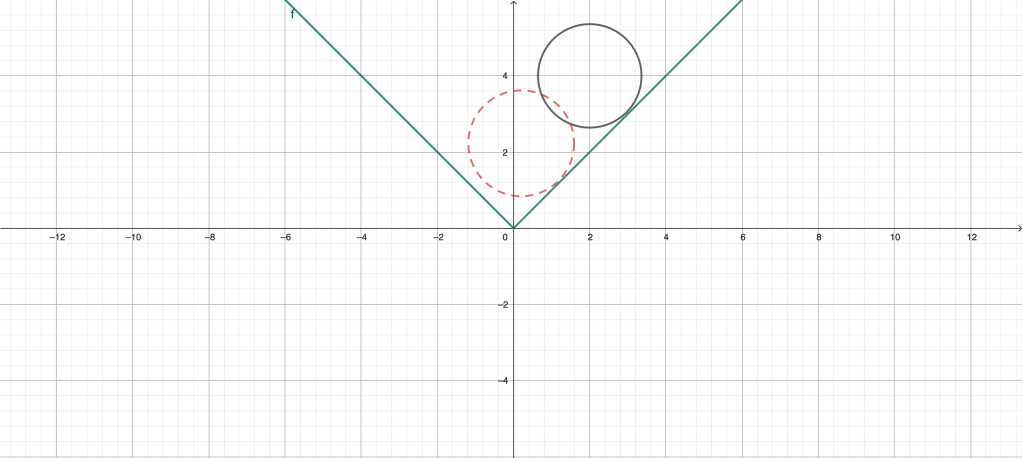
Let us attempt at a different description of a corner. At a corner like the one in , if we roll a disk along the graph in such a way that it remains tangent to the graph and above it at all points, the disk will get stuck no matter how small its radius is. The disk cannot negotiate the vertex: as it rolls toward the corner, there comes a point where its lower arc would dip below the graph on the other side. If we think of the graph as a wall, the disk will get stuck at some point, preventing it from reaching the corner. See graph below.
If we round off the corner, by considering the graph of defined as if and if , then any disk of radius can be rolled along the graph without losing contact with it. (Larger disks clearly do not work). Notice that is in , as the curvature jumps at the points of transition between the circle and the straight parts of the graph.
Thus it seems reasonable to adopt the following definition: a corner is a point where an arbitrarily small rolling disk gets stuck, in the sense that it cannot remain both tangent to the graph and on the epigraph at all times. For such definition to make sense, however, we need our graph to be at least so the tangent is well defined at each point. But wait a minute…we shouldn’t expect corners to appear on a graph, should we?
The goal of this post is to show that under the above slightly relaxed definition of “corner”, we can indeed have corners on graphs. In other words, our “rolling disk” definition is strictly weaker than the lack of -regularity.
More precisely, assume we have a smooth function of class . Imagine a disk of radius rolling along the graph of , always tangent to it and always contained in the epigraph. As the disk rolls, its center sits on the normal line at distance from the point of tangency (the normal is well defined for a graph).
Now we ask ourselves: given a graph, can we choose a sufficiently small radius in such a way that a disk of radius can roll along the graph without getting stuck at some point?
Rolling the disk along the concave sections of the curve where is decreasing is clearly possible for some small value of . However, convex sections of the curve pose a challenge. To start, let us assume that , so the curvature and the osculating circle are well defined at all points. It can be easily proved that a disk, tangent to the graph at a point where is locally convex, must lie inside the osculating disk. Therefore, to be able to roll a disk of radius along the graph, we need not to exceed the minimum of the radius of curvature. For a curve, the curvature at a point is
,
and the radius of curvature (the radius of the osculating circle) is . A disk of radius can stay tangent and contained in the epigraph along the curve only if does not exceed the radius of curvature,
at every . In terms of the curvature, the above condition reads . If the curvature is bounded above, then a sufficiently small disk can roll along the entire curve. In particular, if the curve is of class then a sufficiently small disk can be rolled along the curve over any given closed interval . The radius of the disk obviously depends on the upper bound of the curvature on . Such upper bound exists as a consequence of the continuity of on the closed interval .
However, such choice of the radius may be impossible for curves which are merely . As an example, consider the curve
.
The function is differentiable everywhere, including the origin, where the derivative is zero. In fact, it is of class : the first derivative
is continuous at , since as .
So the curve has a well-defined tangent line at every point, including the origin where it is horizontal, . There is no sharp point. If you zoom in, it looks smoother and smoother, flatter and flatter.
And yet, a disk of positive radius rolling along this curve cannot reach the origin. Why? Because a circle of radius tangent at the origin behaves like as . Since , we have
.
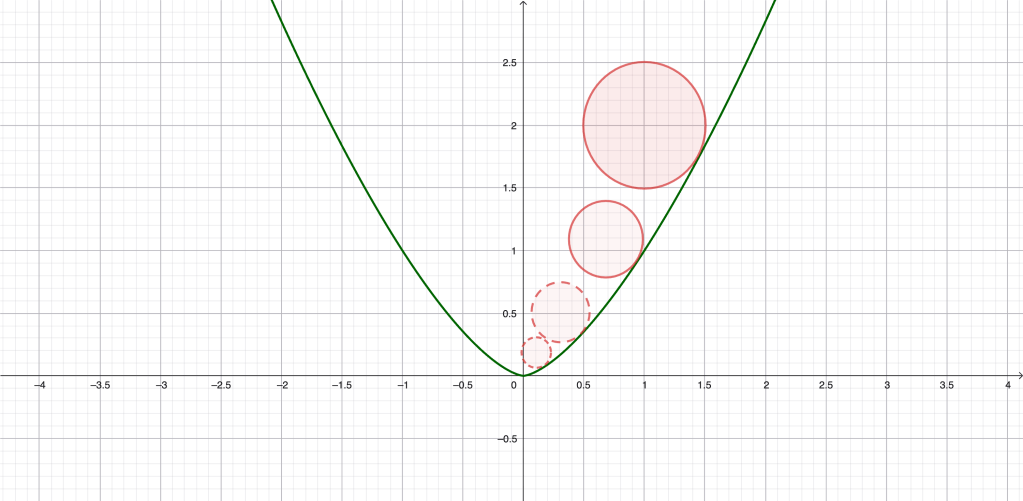
The curve rises faster than any tangent circle. So any disk tangent at the origin dips below the graph, no matter how small its radius. Actually, any disk gets stuck before it ever gets to the origin. Indeed, we have
,
which blows up as . The origin is a point of “infinite curvature” and any disk, no matter how small, will get stuck before reaching it, pretty much as in the case of at . Thus the origin is a corner according to the rolling disk definition. But it is invisible to the eye. There is no angle, no cusp, no discontinuity. Just a point where the curvature blows up. In other words, corners in the rolling disk sense can occur in places where the curve looks perfectly smooth. See the image below.
The previous analysis gives us a hierarchy of corners, depending on the smoothness of the associated function :
: a sharp corner, like . The tangent line jumps. Obvious.
: a corner can still occur, but it is invisible. The tangent line is continuous, but the curvature blows up. Examples: , etc.
: no corners in the rolling-disk sense. A sufficiently small disk can roll along any compact portion of the graph, or anywhere if the curvature is globally bounded.
The middle category is the interesting one. These are curves that look smooth to the eye (no sharp points, no cusps, no “kinks”) but that a rolling wheel cannot traverse. They are invisible corners.
A physical picture
Imagine a train on a track shaped like . The train has wheels of some fixed radius. As it approaches the origin, the track becomes flatter and flatter, but the rate at which it is becoming flatter increases. At some point, the wheels lose contact with the track, or the train derails, because the track’s curvature exceeds what the wheel geometry can accommodate.
The train cannot reach the origin. The track has a corner there. A corner that no passenger can see.




: a sharp corner, like
: a corner can still occur, but it is invisible. The tangent line is continuous, but the curvature blows up. Examples:
, etc.


