The phrase “compact sets behave as finite sets” or “compactness is the property that replaces finiteness for infinite sets” is common in analysis and topology. My goal in this post is to flesh out this idea: in which precise way does compactness serve as a substitute for finiteness?
Let us begin by noting that the modern concept of compactness is the summit of a decades-long evolution, starting with B. Bolzano’s 1817 paper, in which he recognized the importance of what we now call the least upper bound property (Dedekind’s completeness) of the real numbers. Bolzano’s own statement reads:
“If a property 


Bolzano used this property as a stepping stone in his proof of the Intermediate Value Theorem (IVT) for continuous functions on an interval. His work remained largely unknown until Weierstrass presented a similar result in his lectures around 1860.
The least upper bound property readily implies the following:
Theorem (Bolzano-Weierstrass). Every bounded sequence of real numbers contains a convergent subsequence.
The theorem is trivial if the range of the sequence is finite: by the pigeonhole principle, some value repeats infinitely often, yielding a constant convergent subsequence. The general case can be proved by successive bisection of any interval in which the range of the sequence is contained. At each step, we keep the half that contains infinitely many terms of the sequence. A convergent subsequence is then obtained by choosing terms from successively smaller intervals. The limit of this subsequence is the least upper bound of the sequence of left endpoints (or the greatest lower bound of the right endpoints), whose existence is guaranteed by completeness. Bisection was Bolzano’s favorite method of proof.
For completeness, we recall the theorem that motivated Bolzano:
Theorem (IVP, Bolzano, Cauchy, Weierstrass): If 


![[k,K]](https://s0.wp.com/latex.php?latex=%5Bk%2CK%5D&bg=ffffff&fg=444444&s=0&c=20201002)


The Bolzano–Weierstrass theorem is instrumental in proving existence results of this type. The common feature is that a desired real number must be constructed via a limit process, especially when no monotonicity is available and a subsequence suffices.
In the case of IVP, the fact that the “intermediate point” 

Theorem (EVP, Weierstrass, 1850-60) A continuous function on a closed, bounded interval attains its maximum and its minimum.
The key word here is, of course, “attains”. To construct the point where, say, the maximum is achieved, the Bolzano-Weierstrass property can be applied to a maximizing sequence but we also need the limit point to be in the domain, and that can be guaranteed if the interval is closed. A function like 
![(0,1]](https://s0.wp.com/latex.php?latex=%280%2C1%5D&bg=ffffff&fg=444444&s=0&c=20201002)
Any function whose domain is a finite set trivially achieves its maximum and its minimum. In other words, one can always pick the max and the min of a finite set of numbers. Such property is false for general infinite sets . It turns out, however, that the same is true for continuous functions if the domain is both bounded and closed.
Combining the IVP and the EVP, we conclude that the continuous image of an interval ![[a,b]](https://s0.wp.com/latex.php?latex=%5Ba%2Cb%5D&bg=ffffff&fg=444444&s=0&c=20201002)
![[c,d]](https://s0.wp.com/latex.php?latex=%5Bc%2Cd%5D&bg=ffffff&fg=444444&s=0&c=20201002)
![c=\min_{[a,b]}f(x)](https://s0.wp.com/latex.php?latex=c%3D%5Cmin_%7B%5Ba%2Cb%5D%7Df%28x%29&bg=ffffff&fg=444444&s=0&c=20201002)
![d=\max_{[a,b]}f(x)](https://s0.wp.com/latex.php?latex=d%3D%5Cmax_%7B%5Ba%2Cb%5D%7Df%28x%29&bg=ffffff&fg=444444&s=0&c=20201002)
The above considerations naturally lead to the concept of compact set of real numbers as a set which is both bounded and closed. Boundedness guarantees the existence of a convergent subsequence of points whose limit satisfies certain property; closedness ensures that the limit point remains in the set.
This is a vivid illustration of the principle put forward by Imre Lakatos in “Proofs and Refutations”: new concepts arise from the process of constructing formal proofs through a sequence of guesses, each refuted by counterexamples, until all gaps are filled. Along the way, assumptions are added to guarantee correctness, and proof-generated definitions emerge by combining the necessary assumptions – what Lakatos called “monster-barring.”
In many instances in Analysis, it is not about constructing a limit element but about proving that a local property is actually global. Usually, a property being global depends on the possibility of choosing a universal object in the sense that it works locally at every point of the given (infinite, possibly continuous) domain. The following theorem illustrates this beautifully:
Theorem (Heine – Cantor): A continuous function on a bounded, closed interval
We recall that uniform continuity is about the possibility of choosing, for each 


Uniform continuity is obvious for functions defined on a finite domain, as we can just choose
Assume the opposite. Negating the definition of uniform continuity means there exists some specific 


Next, we use compactness (that is, Bolzano-Weierstrass plus closedness) to extract a convergent subsequence 

![x_0\in [a,b]](https://s0.wp.com/latex.php?latex=x_0%5Cin+%5Ba%2Cb%5D&bg=ffffff&fg=444444&s=0&c=20201002)


Finally, we use continuity at 
Consequently, ![\lim [f(x_{n_k}) - f(y_{n_k})]=0](https://s0.wp.com/latex.php?latex=%5Clim+%5Bf%28x_%7Bn_k%7D%29+-+f%28y_%7Bn_k%7D%29%5D%3D0&bg=ffffff&fg=444444&s=0&c=20201002)
The key idea here is constructing a final, “limit” point to which the local property applies, preventing the sequence of
This notion of compactness based on the Bolzano-Weierstrass property generalizes naturally to metric spaces. In this setting, a metric space 

Examples of compact metric spaces are: finite subsets of a metric space, closed and bounded intervals in 

In infinite-dimensional spaces, compactness is strictly stronger than boundedness + closedness. Compact subsets of infinite-dimensional spaces are more rare and special. To get compactness, you must add a strict condition that forces the set to be “finite-dimensional in behavior” (meaning its elements must be uniformly small in the infinitely many directions). A paradigmatic example is the Hilbert cube
![[0,1]\times[0,1/2]\times[0,1/3]\times\dots](https://s0.wp.com/latex.php?latex=%5B0%2C1%5D%5Ctimes%5B0%2C1%2F2%5D%5Ctimes%5B0%2C1%2F3%5D%5Ctimes%5Cdots&bg=ffffff&fg=444444&s=0&c=20201002)
considered as a metric subspace of 
![C[0,1]](https://s0.wp.com/latex.php?latex=C%5B0%2C1%5D&bg=ffffff&fg=444444&s=0&c=20201002)
![S:=\{f\in C[0,1]: |f|\le K, |f(x)-f(y)|\le L|x-y|\}](https://s0.wp.com/latex.php?latex=S%3A%3D%5C%7Bf%5Cin+C%5B0%2C1%5D%3A+%7Cf%7C%5Cle+K%2C+%7Cf%28x%29-f%28y%29%7C%5Cle+L%7Cx-y%7C%5C%7D&bg=ffffff&fg=444444&s=0&c=20201002)
for some 
![x,y\in[0,1]](https://s0.wp.com/latex.php?latex=x%2Cy%5Cin%5B0%2C1%5D&bg=ffffff&fg=444444&s=0&c=20201002)
For the Hilbert cube, shrinking bounds on coordinates provide such uniform control along dimensions. In contrast, the unit ball in
Examples of non-compact subsets are: any non-closed or unbounded subset in any metric space, the subset of functions 

A different point of view on compactness, which historically ran parallel to the above “sequential” one originated with Dirichlet (1850’s), Heine (1870’s) and formalized by Borel (1890’s) is related to the concept of cover/subcover. Namely, in the proof given by Dirichlet of the last theorem above he used the following fact implicitly: if a closed, bounded interval is covered by intervals, then a finite subcover can be extracted. In this concrete application, we can cover the given interval 
This property is trivial for finite sets. Indeed, consider a finite set of points, say 


For infinite sets, the property is far from trivial. Eventually, it was realized that for metric spaces, sequential compactness and the Heine – Borel property are equivalent. However, it is the covering definition that has become the standard in general topology. The reason is that sequences are not powerful enough to detect compactness or closedness in arbitrary (non-metric) topological spaces. In spaces that are not first-countable (where points may lack a countable neighborhood basis) sequences are “blind” to some topological structure. A classic counterexample is the product of uncountably many copies of ![[0,1]](https://s0.wp.com/latex.php?latex=%5B0%2C1%5D&bg=ffffff&fg=444444&s=0&c=20201002)
![X = [0, 1]^{\mathbb{R}}](https://s0.wp.com/latex.php?latex=X+%3D+%5B0%2C+1%5D%5E%7B%5Cmathbb%7BR%7D%7D&bg=ffffff&fg=444444&s=0&c=20201002)
![f:\mathbb{R}\to [0,1]](https://s0.wp.com/latex.php?latex=f%3A%5Cmathbb%7BR%7D%5Cto+%5B0%2C1%5D&bg=ffffff&fg=444444&s=0&c=20201002)
The Russian topologists Pavel Alexandrov (1896–1982) and Pavel Urysohn (1898–1924) are widely credited with establishing the modern definition: a space is compact if every open cover has a finite subcover. They recognized this as the most robust and powerful formulation – one that yields the strongest theorems, including Tychonoff’s theorem and Urysohn’s Lemma.
Compactness of a generic set depends on the topology. However, finite sets are guaranteed to be compact no matter what the topology on the space might be. On the other hand, if the topology is the discrete topology, in which every set is open, compact sets are necessarily finite. Since we usually deal with coarser topologies, larger families of compact subsets arise. Yet another way to understand this is by noticing that, having less open sets, it becomes easier for an open cover to contain a finite subcover.
Thus, from Bolzano’s bisection to Tychonoff’s theorem, the driving idea remains constant: compactness is the topological device that lets us treat infinite domains with the same certainty we reserve for finite ones – provided we choose the right topology for the job.
 are considered (say, a course on Galois theory), you encounter the concepts of algebraic and transcendental numbers. Rational numbers can be thought as the ones solving a linear equation
  with integer coefficients,
  . A natural generalization leads us to the definition of algebraic numbers as real numbers satisfying a polynomial equation of the form
  with integer coefficients
  . The degree of an algebraic number is the lowest degree of a polynomial with integer coefficients having the given number as a root. Such polynomial has to be irreducible in
 ![\mathbb{Z}[x]](https://s0.wp.com/latex.php?latex=%5Cmathbb%7BZ%7D%5Bx%5D&bg=ffffff&fg=444444&s=0&c=20201002) , otherwise the said number would be a root of a lower degree polynomial. Real numbers which are not algebraic are called transcendental. Clearly, all rational numbers are algebraic, and all transcendental numbers are irrational.
, otherwise the said number would be a root of a lower degree polynomial. Real numbers which are not algebraic are called transcendental. Clearly, all rational numbers are algebraic, and all transcendental numbers are irrational. ,
,  , and the Euler-Mascheroni constant
  or Apéry’s constant
  are mentioned as candidates (it is not even known if those are irrational). Proving that
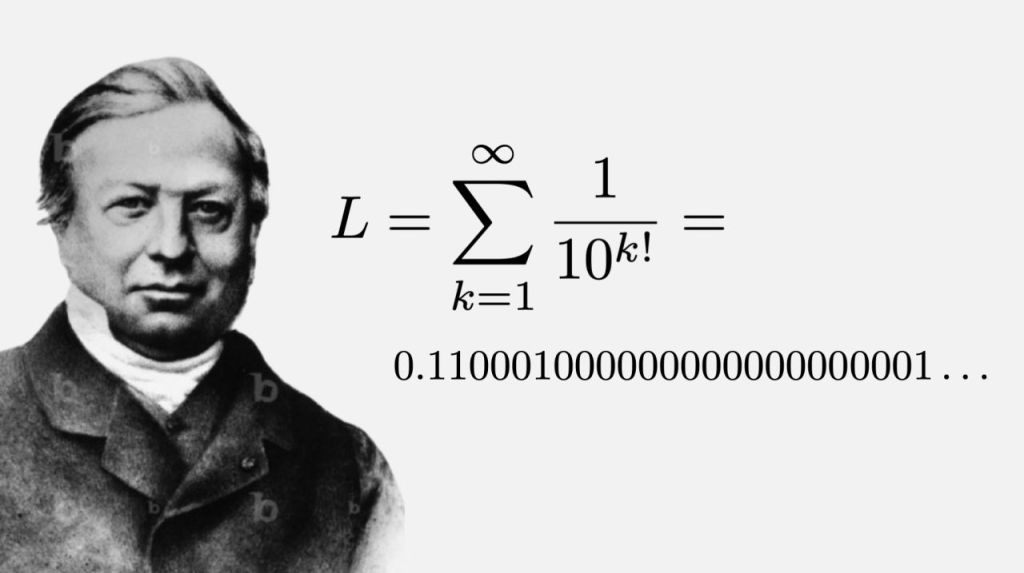
  ,
, where the “ones” appear at positions given by the factorials,
  after the decimal point. Not being periodic,
  is clearly irrational.
 be an irrational algebraic number of degree
  (i.e.,
  such that for all rational numbers
  (with
(with  ) we have
 .
. should be contrasted with the well known fact that the continued fraction convergents
  of any irrational number
  .
. are rational numbers with denominator
  . It is clear that

 and
and  clearly contradict each other for large
  . Indeed, for large enough
  ,
, . Thus,
 . If
. If  is a rational number in lowest terms (
 , then
  is a non-zero integer,
 .
. to
to  via the Mean Value Theorem,
 between
  , then
  and the previous estimate entails
 .
. .
. might appear ‘chaotic’ in its decimal expansion, yet it is fundamentally structured: as a quadratic irrational, its continued fraction is perfectly periodic,
 .
. for all
  with
with  , exponential functions
  with
with  , the function
  , etc.
 is a strictly increasing (hence one-to-one) function. Such correspondence allows to identify
  . In other words,
  can be used as a new independent variable. At this point, one might be tempted to use the function
  , where
  ) as an alternative representation of
  that has the following pleasant additional property: if the procedure is applied twice we recover the original function,
  . The transformation
  is what is called involutive (an involution).
 axis starting from
  . Assuming that
  , there will be a first point of contact with the graph of
  – axis; more precisely, if our line has equation
  , we define
  . The knowledge of the function
  at
at  and
and  are represented.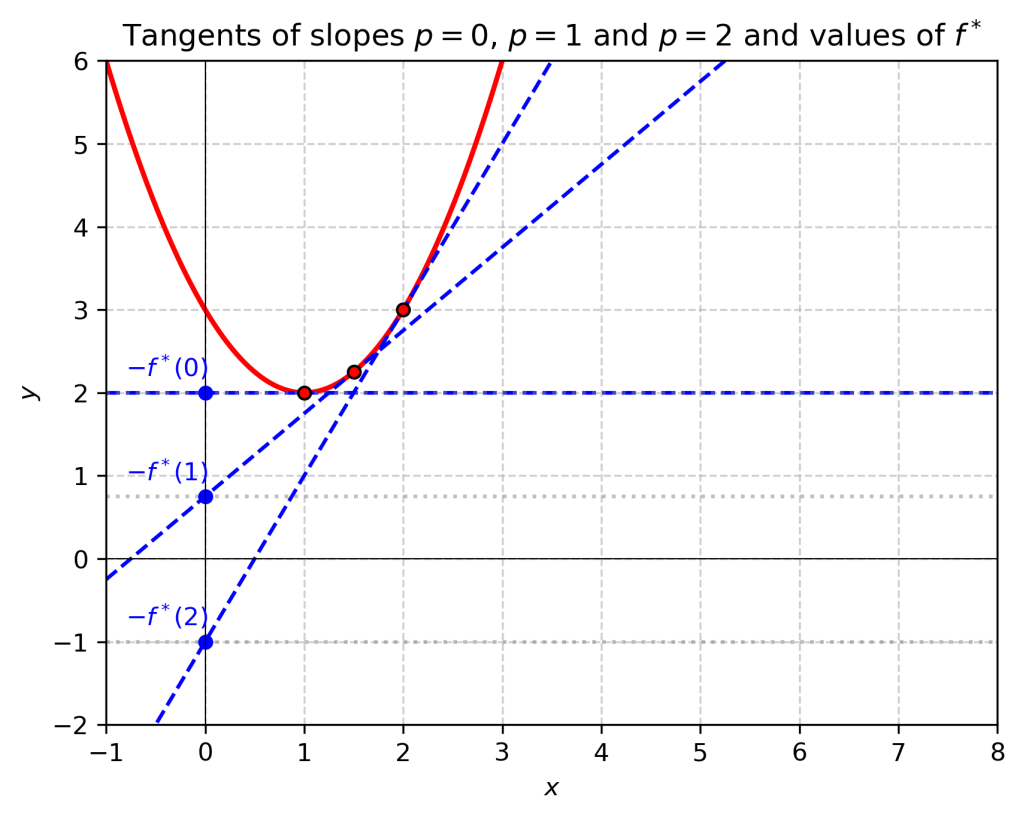
 in the equation
 . Its
. Its  . Finally,
 .
. .
.
 . The formula above reveals that
  , (i.e. the transformation is involutive), since
![\displaystyle{\frac{df^*(p)}{dp}=x(p)+p\frac{dx}{dp}-f'(x(p))\frac{dx}{dp}=x(p)+\frac{dx}{dp}\left[p-f'(x(p))\right]=x(p)}](https://s0.wp.com/latex.php?latex=%5Cdisplaystyle%7B%5Cfrac%7Bdf%5E%2A%28p%29%7D%7Bdp%7D%3Dx%28p%29%2Bp%5Cfrac%7Bdx%7D%7Bdp%7D-f%27%28x%28p%29%29%5Cfrac%7Bdx%7D%7Bdp%7D%3Dx%28p%29%2B%5Cfrac%7Bdx%7D%7Bdp%7D%5Cleft%5Bp-f%27%28x%28p%29%29%5Cright%5D%3Dx%28p%29%7D&bg=ffffff&fg=444444&s=0&c=20201002)
 . This point is a global maximum. Thus,
 .
.
 . Equality takes place when
  ,
,  . More generally, if
  with
with  for
for  , then
  , where
  . If
. If  , then
  , etc.
 in the range of
  , however, is not completely satisfactory for non-convex functions, as it loses information about the original function. However, for a convex function defined on
  , a fact known as the Fenchel-Moreau theorem, [3]. Namely,
 ,
, , an extra technical condition is needed on
  to hold, namely lower semicontinuity, which is equivalent to the closedness of its epigraph. It is easy to see that this is a necessary condition for
  , then clearly
  , with
  . If
. If  when
when  and
and  when
when  , with
  and
and  , then
 ![p\in [a_1,a_2]](https://s0.wp.com/latex.php?latex=p%5Cin+%5Ba_1%2Ca_2%5D&bg=ffffff&fg=444444&s=0&c=20201002) , where it is linear and ranges from
, where it is linear and ranges from  to
to  . In general, to each “corner” of a polygonal graph there corresponds a segment on the graph of
  is straightforward. Under the smoothness and strict convexity assumption
 ,
,  is one-to-one. If
  via the standard Euclidean structure, we define the Legendre transform by
 ,
, denotes the inner product. Much like in the one-dimensional case, the previous definition is equivalent to
  .
. ,
,![f^*:\mathbb{R}^n\to (-\infty,+\infty]](https://s0.wp.com/latex.php?latex=f%5E%2A%3A%5Cmathbb%7BR%7D%5En%5Cto+%28-%5Cinfty%2C%2B%5Cinfty%5D&bg=ffffff&fg=444444&s=0&c=20201002) . The Fenchel-Moreau theorem holds without modifications under the extra assumption of lower semicontinuity of
. The Fenchel-Moreau theorem holds without modifications under the extra assumption of lower semicontinuity of  is a function of two variables, one can consider its transform with respect to the first variable,
 .
. , the supremum is achieved at the (unique)
  defined by
  .
. and their “conjugates” or “dual” on the cotangent bundle
  . Namely, the transform connects functions of
  with functions of
  , where
  and
and  .
. is Clairaut’s equation
 .
. as solutions. The envelope of the family is a singular solution satisfying
  . But these are precisely the relations defining the Legendre transform of
  on its configuration space (a differentiable, Riemannian manifold) completely describes the system. The actual path
  joining two states
  and
and  is an extremal of the action functional,
![S[q]=\displaystyle{\int\limits_{t_1}^{t_2}} L(q,\dot{q},t)\,dt](https://s0.wp.com/latex.php?latex=S%5Bq%5D%3D%5Cdisplaystyle%7B%5Cint%5Climits_%7Bt_1%7D%5E%7Bt_2%7D%7D++L%28q%2C%5Cdot%7Bq%7D%2Ct%29%5C%2Cdt&bg=ffffff&fg=444444&s=0&c=20201002)
 .
.  ,
,
 ,
, is the generalized momentum, an element of the cotangent fiber at
  . Since

 satisfy the first order Hamiltonian system:
 is called the phase space, and the Hamiltonian function equips it with a remarkable symplectic structure. The Hamiltonian flow (if
  does not depend on time) is a one-parameter subgroup of the group of symplectomorphisms of the phase space. A straightforward consequence is Liouville’s Theorem on the preservation of the phase volume (a cornerstone of Statistical Mechanics) . The Lagrangian approach has, however, certain advantages including: a) it is easier to deal with constraints, even non-holonomic via Lagrange multipliers; b) it is easier to track conserved quantities via Noether’s theorem, c) non-conservative forces can be incorporated, etc.
 is usually a positive definite quadratic function (the kinetic energy of the system) hence convex. The transform of a quadratic form is especially simple: it is just another quadratic form of the conjugate variable. For instance, the Lagrangian of a simple mass-spring system, assuming that the spring is linear and

 ,
, represent the heat (thermal energy) added to the system,
  is the work of the surroundings on the system and the last sum above accounts for the energy added to the system by means of particle exchange. Here,
  is the amount of particles of the
  -th type added to the system, and
  the corresponding chemical potential. The relevant fact here is that
  is an actual differential, whereas the rest of the terms are just differential forms in the configuration space of the system. The term
  involving intensive (
 ) and conjugate extensive variables
  . Thus, for example, in the case of a gas expanding/compressing against the environment, the work done on the gas is
  , where
  is the infinitesimal change of volume and
  is the external pressure. Moreover, according to the second principle, for reversible processes the form
  , namely there is a function of state called entropy

 is the pressure of the gas in equilibrium with its surroundings.
  at pressure
  .
. we have
  ,
,  .
.  we have
 . Thus, the change of enthalpy determines if a given chemical reaction is exothermic or endothermic. Moreover,
  and
and  .
. ,
, ,
, as the pressure-volume work on the system under fixed temperature.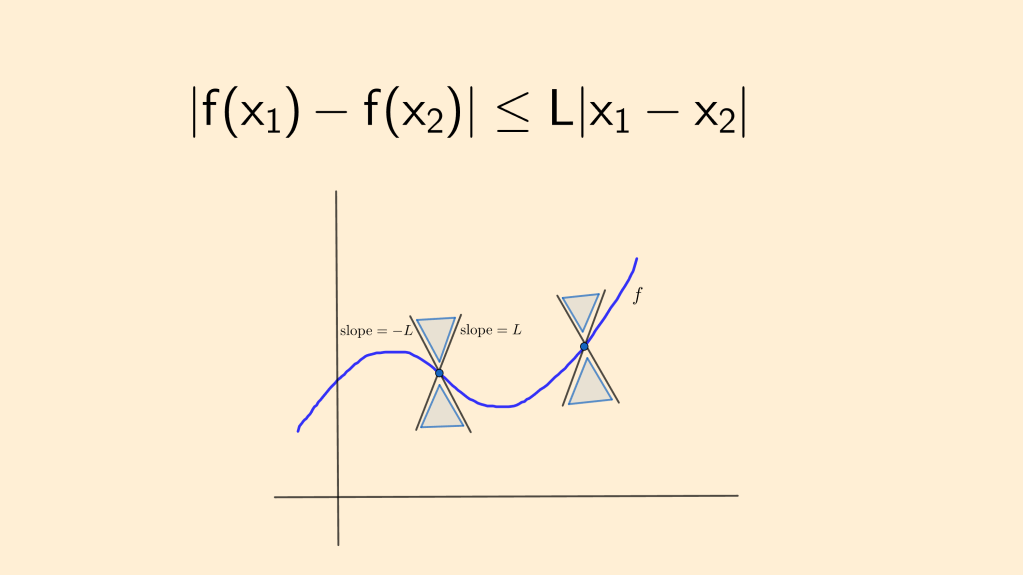

 is Lipschitz continuity of
  where
where  such that
 in
in ![\left\{\begin{array}{l}\displaystyle{ \frac{dx}{dt}=f(t,x)} ;\\[10pt] x(t_0)=x_0 \end{array}\right.\qquad\qquad\qquad \textrm{(IVP)}](https://s0.wp.com/latex.php?latex=%5Cleft%5C%7B%5Cbegin%7Barray%7D%7Bl%7D%5Cdisplaystyle%7B+%5Cfrac%7Bdx%7D%7Bdt%7D%3Df%28t%2Cx%29%7D+%3B%5C%5C%5B10pt%5D+x%28t_0%29%3Dx_0+%5Cend%7Barray%7D%5Cright.%5Cqquad%5Cqquad%5Cqquad+%5Ctextrm%7B%28IVP%29%7D&bg=ffffff&fg=444444&s=0&c=20201002)
 coincide in their intersection. We assume that our solutions are classical,
  , continuously differentiable. Such solutions exist when extra conditions on
  and
and  . We will also assume that
  for every
  and, therefore, one solution of the above IVP is
  . The general case reduces to this one, as we explain later.
 with
with  for some
  can never be zero at
  . We will assume
  , as the case
  can be handled in a similar way. Backwards uniqueness also follows easily from the forward result.
  to zero,
  ,
,  , while
  for
for  . By the Lipschitz condition,

 . Integrating this inequality over
 ![[t,t_1]](https://s0.wp.com/latex.php?latex=%5Bt%2Ct_1%5D&bg=ffffff&fg=444444&s=0&c=20201002) ,
,
 , contradicting the assumption
  as
as  . The Lipschitz condition prevents
  for some
  for some
  for all
  in its domain, thus preventing
 of the IVP
![\left\{\begin{array}{l}\displaystyle{ \frac{dy}{dt}=Ly} ;\\[10pt] y(t_1)=x_1 \end{array}\right.](https://s0.wp.com/latex.php?latex=%5Cleft%5C%7B%5Cbegin%7Barray%7D%7Bl%7D%5Cdisplaystyle%7B+%5Cfrac%7Bdy%7D%7Bdt%7D%3DLy%7D+%3B%5C%5C%5B10pt%5D+y%28t_1%29%3Dx_1+%5Cend%7Barray%7D%5Cright.&bg=ffffff&fg=444444&s=0&c=20201002)
 to the left of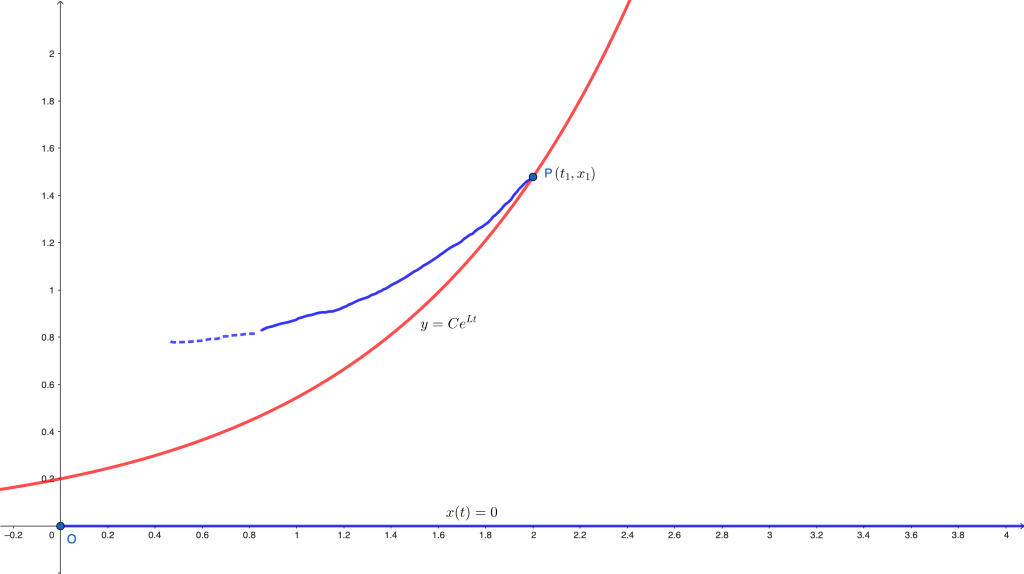
 from reaching the
  )
) 
 to conclude that
  with
with  is a barrier from above for our solution, preventing it from reaching the
  suggests a very natural generalization. Indeed, all we need is a diverging (at zero) improper integral on the right-hand side. We can replace the Lipschitz condition by the existence of a modulus of continuity, that is a continuous function
  with
with  ,
,  for
for  satisfying
 .
. . The proof is identical to the one above, given that the only property we need is the divergence of the improper integral of
  at
at  .
. that leads to a convergent improper integral. This condition is satisfied, for instance, in the autonomous problem
![\left\{\begin{array}{l}\displaystyle{ \frac{dx}{dt}=x^{2/3}} ;\\[10pt] x(0)=0 \end{array}\right.](https://s0.wp.com/latex.php?latex=%5Cleft%5C%7B%5Cbegin%7Barray%7D%7Bl%7D%5Cdisplaystyle%7B+%5Cfrac%7Bdx%7D%7Bdt%7D%3Dx%5E%7B2%2F3%7D%7D+%3B%5C%5C%5B10pt%5D+x%280%29%3D0+%5Cend%7Barray%7D%5Cright.&bg=ffffff&fg=444444&s=0&c=20201002)
 on
on  and
and  for
for  for any
  .
. in this example. Any power
  would do. These examples of non-uniqueness are usually attributed to G. Peano.
 and
and  are local solutions of
  ), then
  is a local solution of
![\left\{\begin{array}{l}\displaystyle{ \frac{d\bar x}{ds}=g(s,\bar x):=f(s+t_0, \bar x+x_1(s+t_0))-f(s+t_0, x_1(s+t_0))} ;\\[10pt] \bar x(0)=0 \end{array}\right.](https://s0.wp.com/latex.php?latex=%5Cleft%5C%7B%5Cbegin%7Barray%7D%7Bl%7D%5Cdisplaystyle%7B+%5Cfrac%7Bd%5Cbar+x%7D%7Bds%7D%3Dg%28s%2C%5Cbar+x%29%3A%3Df%28s%2Bt_0%2C+%5Cbar+x%2Bx_1%28s%2Bt_0%29%29-f%28s%2Bt_0%2C++x_1%28s%2Bt_0%29%29%7D+%3B%5C%5C%5B10pt%5D+%5Cbar+x%280%29%3D0+%5Cend%7Barray%7D%5Cright.&bg=ffffff&fg=444444&s=0&c=20201002)
 with
with  . Moreover,
  satisfies a Lipschitz condition near
  if
if  and hence
  on the corresponding intervals.
 A simple and widely used sufficient condition for
  in an
in an 
 with
with  with
with ![\alpha\in (0,2]](https://s0.wp.com/latex.php?latex=%5Calpha%5Cin+%280%2C2%5D&bg=ffffff&fg=444444&s=0&c=20201002) shows;
shows;  The Lipschitz condition is relevant in other areas of Analysis. For instance, it guarantees the uniform convergence of Fourier series.
 as
as  , assuming that the domain of definition of
 ![\left\{\begin{array}{l}\displaystyle{ \frac{dx}{dt}=x^2} ;\\[10pt] x(t_0)=x_0>0 \end{array}\right.](https://s0.wp.com/latex.php?latex=%5Cleft%5C%7B%5Cbegin%7Barray%7D%7Bl%7D%5Cdisplaystyle%7B+%5Cfrac%7Bdx%7D%7Bdt%7D%3Dx%5E2%7D+%3B%5C%5C%5B10pt%5D+x%28t_0%29%3Dx_0%3E0+%5Cend%7Barray%7D%5Cright.&bg=ffffff&fg=444444&s=0&c=20201002) ,
, “blows up” as
  , despite the fact that
  is smooth on the whole plane. The role of the superlinear growth at infinity is similar to the role of Lipschitz (or Osgood) condition in bounded regions for uniqueness. The above problem is equivalent to
 prevents
  , we have
  . This phenomenon is called finite time blow-up and is exhibited by ODEs with superlinear right-hand-sides, by some evolution PDEs with superlinear sources, etc.
 such that
  as
as  (resp.
  as
as  ) if only
 .
. stays to the left of the solution of
![\left\{\begin{array}{l}\displaystyle{ \frac{dx}{dt}=\Psi(x)} \\[10pt] x(t_0)=x_0 \end{array}\right.](https://s0.wp.com/latex.php?latex=%5Cleft%5C%7B%5Cbegin%7Barray%7D%7Bl%7D%5Cdisplaystyle%7B+%5Cfrac%7Bdx%7D%7Bdt%7D%3D%5CPsi%28x%29%7D+%5C%5C%5B10pt%5D+x%28t_0%29%3Dx_0+%5Cend%7Barray%7D%5Cright.&bg=ffffff&fg=444444&s=0&c=20201002)
 . The latter blows up in finite time, namely at time
  , forcing the solution to our IVP to blow up at some
  .
.

 ) are built.
  , makes correspond, if
  , a multiple of
  we say that the first is to the second as the third is to the fourth,
  if, for any integers
  the following equivalencies hold
 ,
, and
and  . But again, neither those rational approximations or the final ratio were “numbers”.
 ,
,  etc. Bombelli is also responsible for an early use of “imaginary” numbers for the solution of cubic equations.
 with the property
 ,
, as
as  , the other case being completely analogous. When
  we say that the asymptote is horizontal. A simple way to detect if a given function has a slant asymptote is by checking linearity at infinity,
  if the limit
 ,
,
 are polynomials, the situation is much simpler. In order for
  and, if that is the case, we perform long division which leads to
 and, therefore, the asymptote is just the quotient
 , the fraction is superlinear at infinity.
  does not require derivatives at all. In order to understand this, we notice that
  is a tangent to
  at
at 
 as
as  . The last relation is very similar to
  ,
, 
 ,
,  with first partial remainder
  . In the next step, we add
  to the quotient, with a partial remainder
  . Since we are interested in the tangent line and
  is an infinitesimal of degree higher than one at zero, the division stops here and the equation of the tangent is
  . If we keep dividing, we get the Taylor polynomials of higher degree. For instance, the osculating parabola at
  and so on.
  in the decimal representation of numbers by
  at
at  , all we need to do is set
  and express
  and then finding the tangent at
  as before. Finally, we have to replace
  in the found equation of the tangent.
 by
by  is performed in order to get the power series expansion.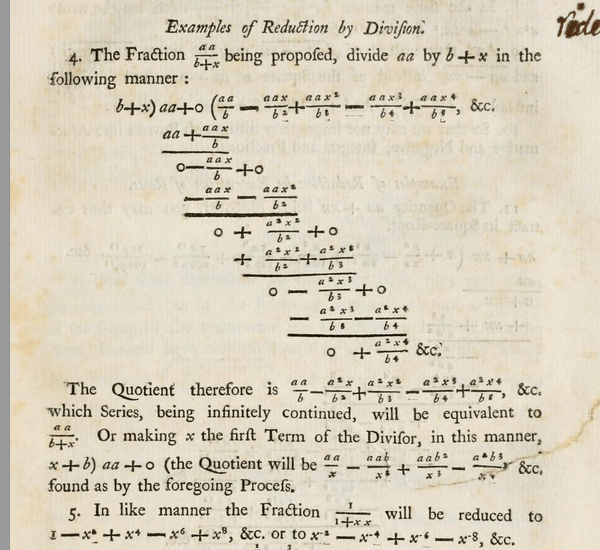


 ,
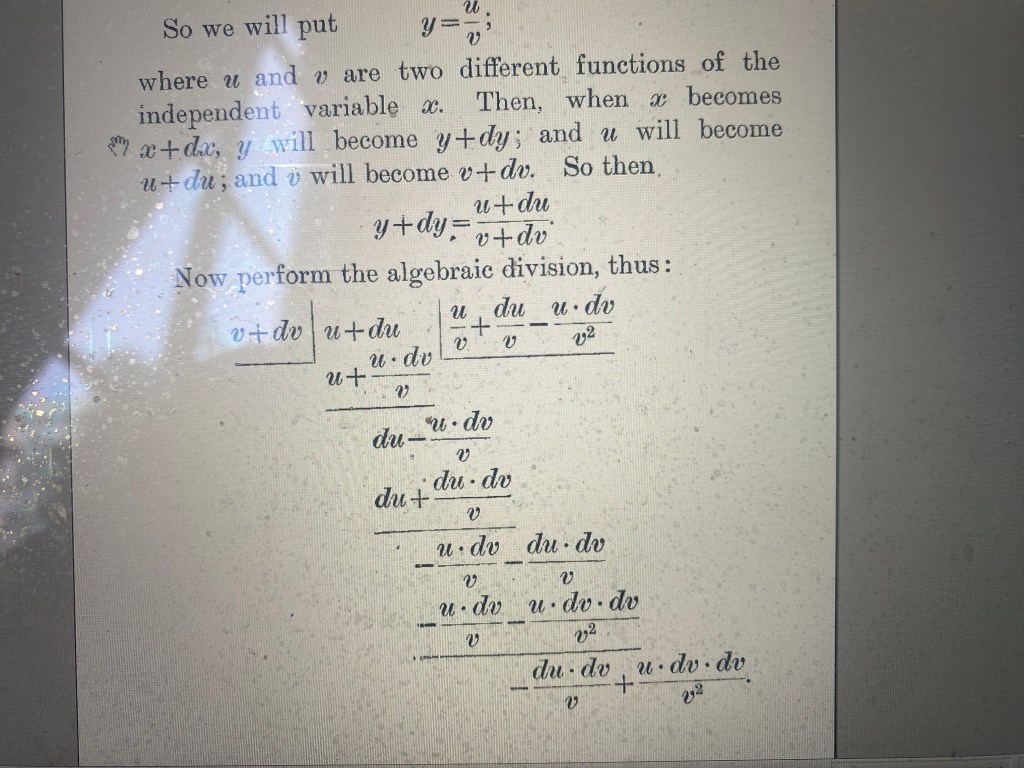
,

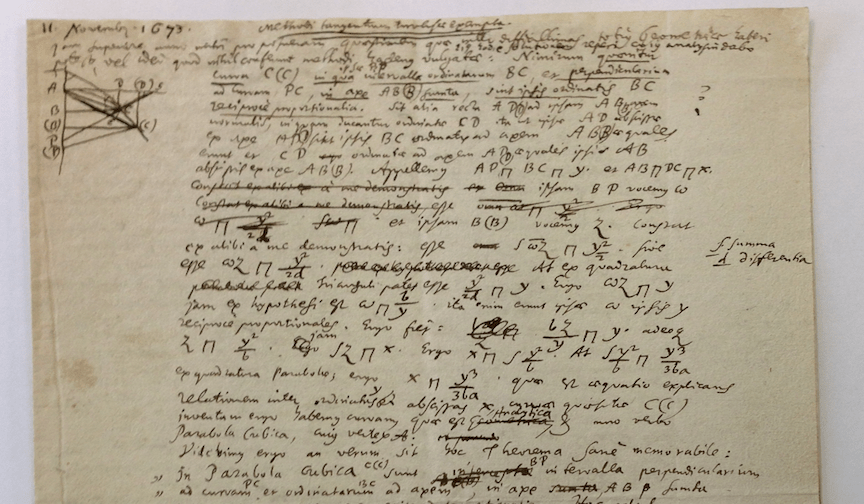
 for sums. He uses the sign
  for adequalities). In the hands of the Bernoullis, Huygens, Euler, Lagrange, Legendre and many others, Infinitesimal Calculus, including the theory of differential equations as well as numerous applications to Mechanics, Optics, etc. developed for over 150 years under that conceptual framework. The situation changed during the second half of the XIX century, when set theory and a rigorous construction of the continuum was put forward by Cantor and Dedekind. Supposedly, they provided a final answer to the nature of the continuum that has been prevalent for over 150 years by now. Such a sparse ontology did not convince everyone, and there have been numerous alternative models of the continuum developed over time, aimed at restoring the language of infinitesimals, see [1]. As for the concepts of derivative and integral, infinitesimal interpretations were replaced by epsilons and deltas at the hands of Bolzano, Cauchy and, notably, Weierstrass.
 , if
, if  , we say that
  if for any
  there exists some
  such that

 , where
  with tags
 ![\xi_i\in [x_{i-1},x_i]](https://s0.wp.com/latex.php?latex=%5Cxi_i%5Cin+%5Bx_%7Bi-1%7D%2Cx_i%5D&bg=ffffff&fg=444444&s=0&c=20201002) and form the Riemann sums
and form the Riemann sums .
. as
as  (uniformly w.r.t. the partitions and the tags), we say that
  there exists
  such that
 , one has to travel half of the distance, then a fourth of the distance, then an eight of it, etc. Zeno rejected the possibility of such process made of infinitely many steps since, in his opinion, it could never be completed. Thus for Zeno and the followers of Parmenides, motion did not exist. Greek mathematics rejected completed infinite processes in general (see [2]) and therefore could not attach a numerical value to the “infinite sum”

 , and then noticing that
  “stabilizes towards
  “, and thus has the real number
  in this example, the sum happens to be a rational number, but the concept of real number allows to attach a sum to series like
 .
.  to have a finite sum in the above sense is that the general term of the sequence converge to zero,
  . Indeed, if
  has to vanish asymptotically. The elementary theory of numerical series shows that this condition is not sufficient and that there are two main mechanisms of convergence:
  .
.  , thus balancing the number of addends
  the terms become arbitrarily small simultaneously, allowing for a “larger” number of addends, namely the continuous sum
![I=[a,b]](https://s0.wp.com/latex.php?latex=I%3D%5Ba%2Cb%5D&bg=ffffff&fg=444444&s=0&c=20201002) . We can think of
. We can think of  as the infinitesimal addends making up the sum. The situation here is more delicate, since all the terms making up the Riemann sums change every time and the values of the sums may not stabilize if the function is too discontinuous. Everything works nicely for continuous functions though.
 , he/she reasons as follows: choose an infinitesimal portion of the bar of length
  between two infinitesimally close points
  . Being infinitesimal, the density is constant and equal to
  . The total mass is thus the sum of the infinitesimal masses
 .
.

 as
as  .
.![I=[a,b]\times[c,d]](https://s0.wp.com/latex.php?latex=I%3D%5Ba%2Cb%5D%5Ctimes%5Bc%2Cd%5D&bg=ffffff&fg=444444&s=0&c=20201002) . Those are double integrals
. Those are double integrals![\displaystyle{\iint\limits_{[a,b]\times[c,d]} f(x,y)\, dxdy}](https://s0.wp.com/latex.php?latex=%5Cdisplaystyle%7B%5Ciint%5Climits_%7B%5Ba%2Cb%5D%5Ctimes%5Bc%2Cd%5D%7D+f%28x%2Cy%29%5C%2C+dxdy%7D&bg=ffffff&fg=444444&s=0&c=20201002) ,
, with respect to
  . The same applies to general multiple integrals. Unbalanced Riemann sums give rise to trivial objects like
![\displaystyle{\iint\limits_{[a,b]\times[c,d]}f(x,y)\,dx^2dy=0};\qquad\displaystyle{\iiint\limits_{[a,b]\times [c,d]\times [e,f]}f(x,y,z)\,dxdz=\infty}](https://s0.wp.com/latex.php?latex=%5Cdisplaystyle%7B%5Ciint%5Climits_%7B%5Ba%2Cb%5D%5Ctimes%5Bc%2Cd%5D%7Df%28x%2Cy%29%5C%2Cdx%5E2dy%3D0%7D%3B%5Cqquad%5Cdisplaystyle%7B%5Ciiint%5Climits_%7B%5Ba%2Cb%5D%5Ctimes+%5Bc%2Cd%5D%5Ctimes+%5Be%2Cf%5D%7Df%28x%2Cy%2Cz%29%5C%2Cdxdz%3D%5Cinfty%7D&bg=ffffff&fg=444444&s=0&c=20201002) ,
, definition of the definite integral. They help understand why the concept of definite integral is relevant as it strikes the sweet spot where the “number of addends” (i.e. the cardinality of the set of indices) and their size balance each other, resulting in convergence to a finite, nontrivial sum.
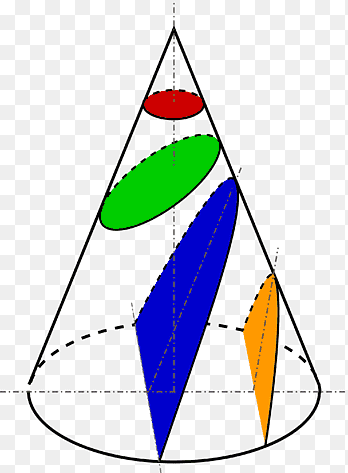

 . In other words, it is the locus of points equidistant from the focus and the directrix. A two line computation gives the equation
 and directrix
  . In a similar fashion the equations for the other conics can be obtained and used to derive further properties. Conic sections correspond to quadratic equations in two variables, a fact first established by Wallis in 1655.
 etc. which can be integrated in quadratures in some cases.
  at a generic point of the sought after curve was (and still is) a valuable tool in the derivation of the differential relations. Let’s look into some examples.
 – plane satisfying the following property: the area of the triangle defined by the tangent, the ordinate and the subtangent is a positive constant
  , its ordinate by
  and the subtangent be
  (figure below).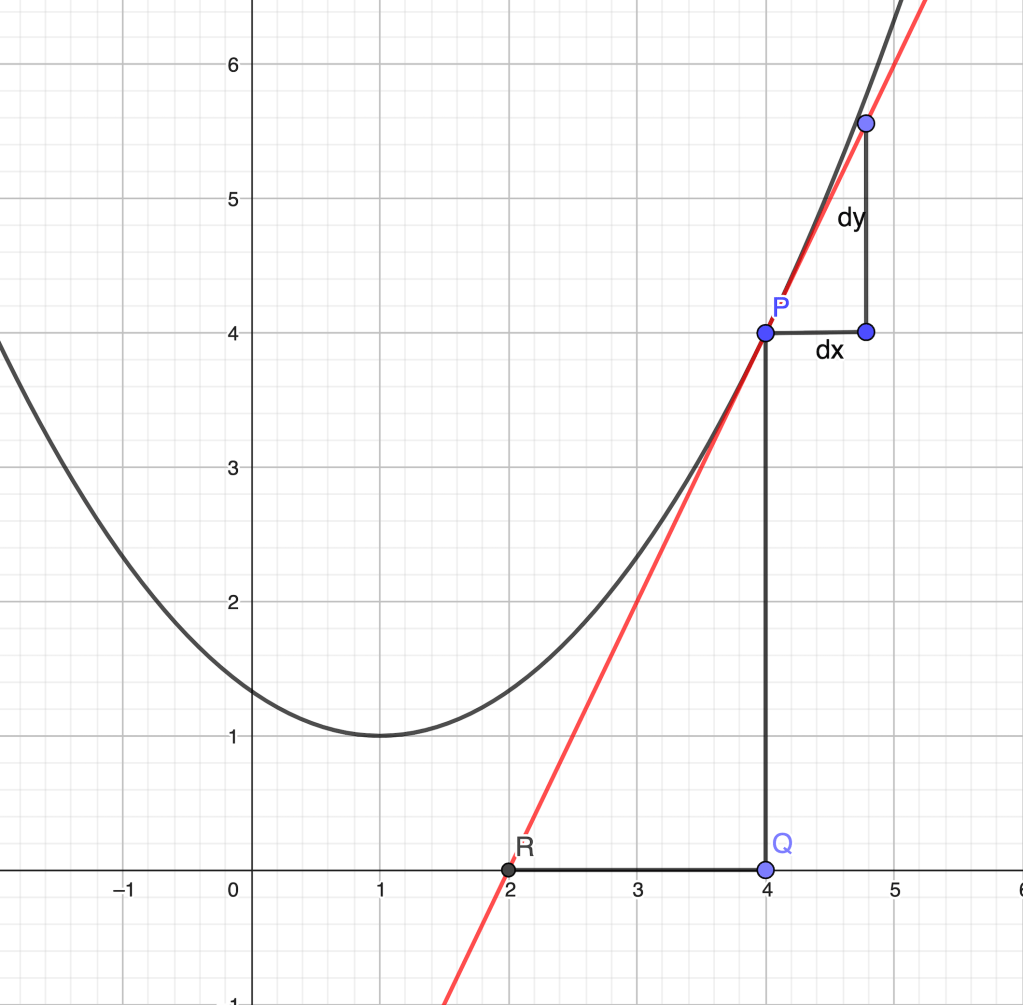
 is tangent to the curve, the triangle
  is similar to the differential triangle at


 ,
, . As we move along one of these hyperbolas, the distance to the
  -axis is inversely proportional to the size of the subtangent.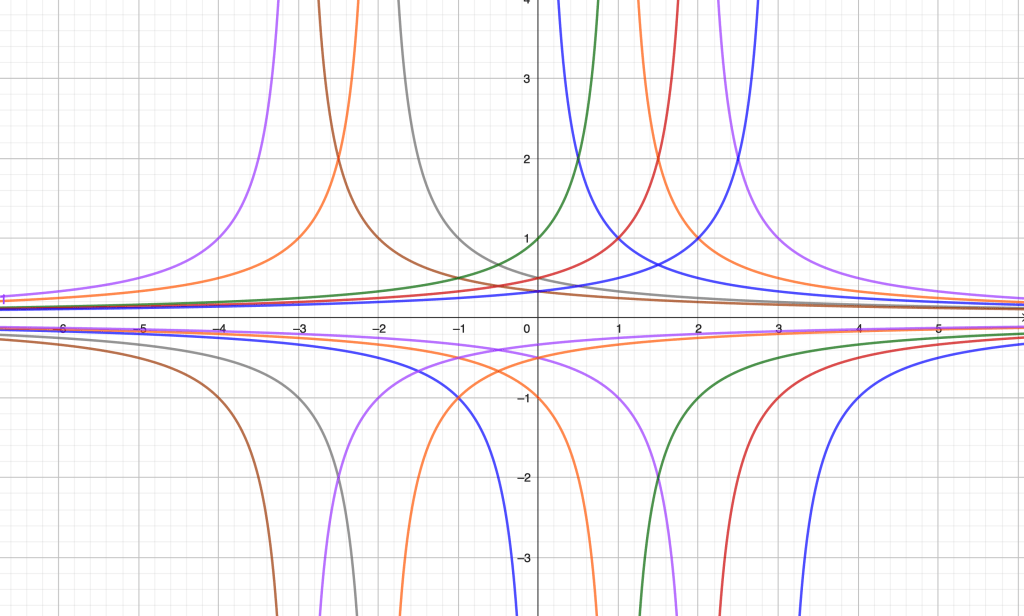
 -axis containing the point where the object is initially located. Let
  . We look at this problem from a strictly geometric point of view, assuming that the object is a mass point that reacts instantly to the pulling force, aligning its motion with the force at all times. In other words, the goal is to find a curve whose segment of tangent between the point of tangency and the
  is the foot of the perpendicular from
  is the abscissa). Here,
  .
.
 .
. 
 .
. then reads
 ,
, ) adding the condition
  gives
gives
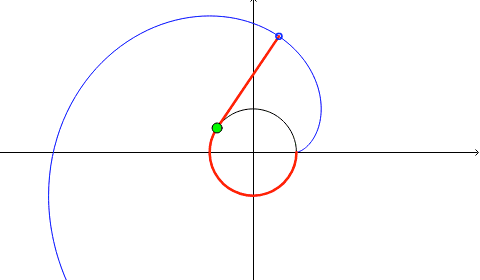
 ,
, (if we think of the parameter
  the coordinates of the point of the involute on the tangent to
  and let
  the length of the detached portion of the string (that is, the arc length measured from the point of detachment, also called natural parameter in Differential Geometry). In the figure below, we assume that the base curve is positively oriented, so the increase of the parameter
  . The string is also being unwrapped counterclockwise.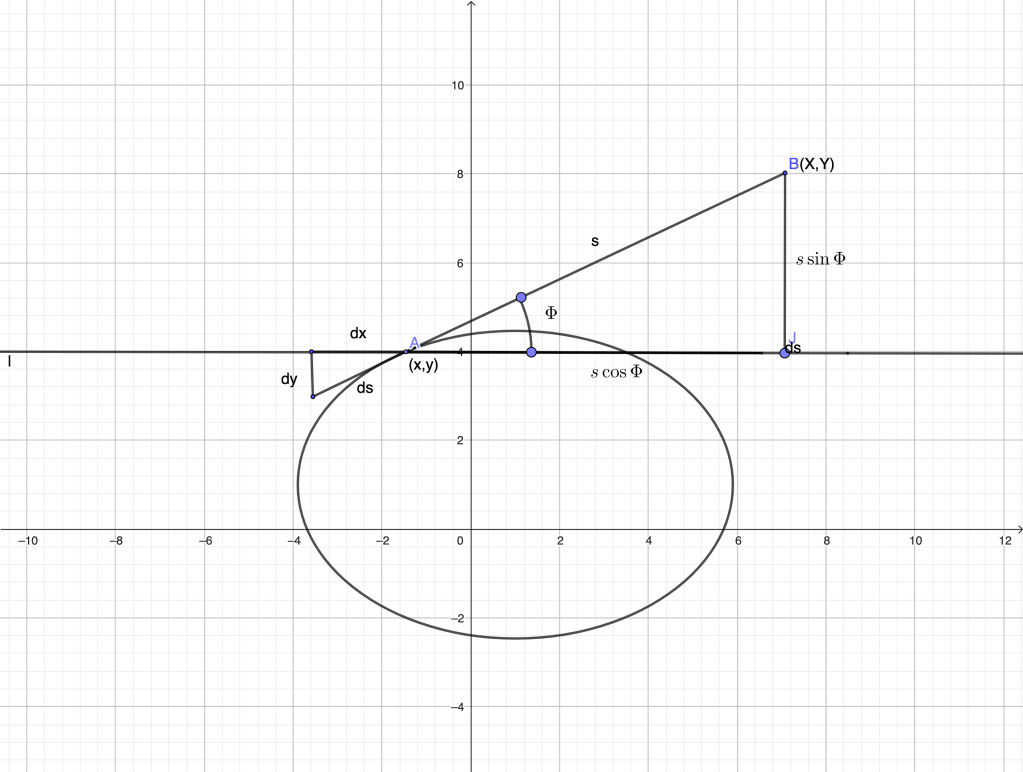
 ,
, is the angle formed by the tangent at
  .
.  .
.  .
. , clearly
  if we choose the point
  as the starting point. An appplication of the general formula gives
 and
and  . It is representative of the Leibnizian calculus of infinitesimals. Remarkably, the result involves second differentials.
 be a portion of a regular curve, with
  and
and  being infinitesimally close points on it. Let the normals to the curve at
  and pick the
  and
and  at points
  . We draw a vertical auxiliary line
  and a horizontal line through
  , and yet another vertical through
  at
at  . Finally, we draw
  , perpendicular to
  (resp.
  ). Our goal is to compute the radius of curvature
  , in terms of
  ,
,  and their differentials
  and
and  . Due to the local nature of
  directly.
 ,
,  ,
,  are all similar (strictly or up to negligible infinitesimals) to the differential triangle
  . From the similarity of
  and
and  we get
 and solving for
  .
. ;
; ;
; .
. .
. (otherwise the point
  we obtain the familiar formula
 .
. , the osculating circle degenerates into a line and
  .
. above. Since
  one has
 ,
, ,
, on the evolute by shifting the point
  by the amount
  .That is,
  .
. , multipliées chacune par un coefficient indéterminé qu’ensuite on égale à zéro la somme de tous les terms qui se trouvent multipliés par une même différentielle… – J. L. Lagrange, “Méchanique Analytique”.
 and therefore their gradients have to be collinear. Despite how appealing this interpretation might be, it does not correspond to the historical development of the method. It is rather an afterthought. A similar example would be motivating Pythagorean theorem using vectors and the inner product in
  . I believe that re-interpreting mathematical facts from a higher perspective is very useful but using those re-interpretations as motivation is misleading.
 ,
,  . Let the total force acting on the
  . If there are no constraints on the particles, all possible displacements
  are admissible and, according to the principle of virtual displacements, the system is in equilibrium if and only if
 . By freezing all of the
  ‘s but one, we see that each of the addends in the above sum has to vanish, that is
 .
.  are arbitrary, this in turn implies
 ,
, ,
, – dimensional space and therefore to their (generically)
  – dimensional intersection, a manifold in
  . To calculate those virtual displacements, we differentiate each one of the above equations, yielding
![\left\{\begin{array}{l}\displaystyle{\frac{\partial g_1}{\partial \mathbf{r}_1}\cdot d\mathbf{r}_1+\frac{\partial g_1}{\partial \mathbf{r}_2}\cdot d\mathbf{r}_2+\dots \frac{\partial g_1}{\partial \mathbf{r}_N}\cdot d\mathbf{r}_N=0}\\ [15pt]\displaystyle{\frac{\partial g_2}{\partial \mathbf{r}_1}\cdot d\mathbf{r}_1+\frac{\partial g_2}{\partial \mathbf{r}_2}\cdot d\mathbf{r}_2+\dots \frac{\partial g_2}{\partial \mathbf{r}_N}\cdot d\mathbf{r}_N=0}\\[15pt]\cdots\cdots\cdots\cdots\end{array}\qquad\qquad\qquad\quad (2)\right.](https://s0.wp.com/latex.php?latex=%5Cleft%5C%7B%5Cbegin%7Barray%7D%7Bl%7D%5Cdisplaystyle%7B%5Cfrac%7B%5Cpartial+g_1%7D%7B%5Cpartial+%5Cmathbf%7Br%7D_1%7D%5Ccdot+d%5Cmathbf%7Br%7D_1%2B%5Cfrac%7B%5Cpartial+g_1%7D%7B%5Cpartial+%5Cmathbf%7Br%7D_2%7D%5Ccdot+d%5Cmathbf%7Br%7D_2%2B%5Cdots+%5Cfrac%7B%5Cpartial+g_1%7D%7B%5Cpartial+%5Cmathbf%7Br%7D_N%7D%5Ccdot+d%5Cmathbf%7Br%7D_N%3D0%7D%5C%5C+%5B15pt%5D%5Cdisplaystyle%7B%5Cfrac%7B%5Cpartial+g_2%7D%7B%5Cpartial+%5Cmathbf%7Br%7D_1%7D%5Ccdot+d%5Cmathbf%7Br%7D_1%2B%5Cfrac%7B%5Cpartial+g_2%7D%7B%5Cpartial+%5Cmathbf%7Br%7D_2%7D%5Ccdot+d%5Cmathbf%7Br%7D_2%2B%5Cdots+%5Cfrac%7B%5Cpartial+g_2%7D%7B%5Cpartial+%5Cmathbf%7Br%7D_N%7D%5Ccdot+d%5Cmathbf%7Br%7D_N%3D0%7D%5C%5C%5B15pt%5D%5Ccdots%5Ccdots%5Ccdots%5Ccdots%5Cend%7Barray%7D%5Cqquad%5Cqquad%5Cqquad%5Cquad+%282%29%5Cright.&bg=ffffff&fg=444444&s=0&c=20201002)

 for all
  independent ones and substitute into
  . Then
  ,
, , etc. are the partial derivatives of some function
  has to be non-zero if
  and add it to the first. Thus at any given point we can choose

 , we get the equilibria.
 and add their sum to
  . We choose the multipliers in order to remove
  , otherwise no freedom is left for the system. For example, one particle in space can be subject to lie on a surface or on a line (the intersection of two surfaces). Adding one more constraint would completely fix its position.
  . When the work of a force can be put in the form
  ,
,
 stands for the mass of the
  for its acceleration.
![\left\{\begin{array}{l}-mx''+F_x+\lambda\frac{\partial g}{\partial x}=0\\[15pt]-my''+F_y+\lambda\frac{\partial g}{\partial y}=0\\[15pt]-mz''+F_z+\lambda\frac{\partial g}{\partial z}=0\end{array}\right.](https://s0.wp.com/latex.php?latex=%5Cleft%5C%7B%5Cbegin%7Barray%7D%7Bl%7D-mx%27%27%2BF_x%2B%5Clambda%5Cfrac%7B%5Cpartial+g%7D%7B%5Cpartial+x%7D%3D0%5C%5C%5B15pt%5D-my%27%27%2BF_y%2B%5Clambda%5Cfrac%7B%5Cpartial+g%7D%7B%5Cpartial+y%7D%3D0%5C%5C%5B15pt%5D-mz%27%27%2BF_z%2B%5Clambda%5Cfrac%7B%5Cpartial+g%7D%7B%5Cpartial+z%7D%3D0%5Cend%7Barray%7D%5Cright.&bg=ffffff&fg=444444&s=0&c=20201002)

 The above method can be applied if the constraints are time-dependent (rheonomic). Precisely, if we have just one particle and a constraint of the form
 , virtual displacements
  satisfy the same equation as before (second equation in
  linear in the velocities). See [3].
 Holonomic constraints can be completely eliminated by introducing independent generalized coordinates which implicitly account for them. Thus if
  ,
,  are generalized coordinates of the system and its kinetic energy is
  , we can write the equations of motion in the (Lagrangian) form
 ,
, are generalized forces, [3]. By solving this second order system of equations we find the dynamics
  . But in some cases we are interested in the forces of constraint. One way to find them would be to substitute into Newton’s second law and solving for the unaccounted forces. However, it is generally more convenient to use dependent generalized coordinates in combination with the method of multipliers to deal with constraints and find the forces of constraint as above.
  If all the constraints are holonomic and forces are conservative with potential energy
![\displaystyle{S[\mathbf{q}]=\int\limits_{t_1}^{t_2}L(\mathbf{q}',\mathbf{q},t)\,dt}](https://s0.wp.com/latex.php?latex=%5Cdisplaystyle%7BS%5B%5Cmathbf%7Bq%7D%5D%3D%5Cint%5Climits_%7Bt_1%7D%5E%7Bt_2%7DL%28%5Cmathbf%7Bq%7D%27%2C%5Cmathbf%7Bq%7D%2Ct%29%5C%2Cdt%7D&bg=ffffff&fg=444444&s=0&c=20201002) ,
, are, as before, generalized coordinates on the
  – dimensional manifold
  is the kinetic energy and
  is the Lagrangian of the system. The true motion
  .
. particles is straightforward.
 by their perturbed values
  and disregard infinitesimals which are of order higher than one with respect to
  in the resulting expression.
  for some constants
  , we have
 ,
, . In this case, the expression is linear in
  and
and  and, therefore
 .
. , we notice that
 , we get
  .
.

 ,
,
 ,
, . Finally, since
  we get
 .
.
 . For negative integer powers the same rule applies, as follows from the quotient and power rules. Combining the previous, we can differentiate any equation involving polynomial or rational functions.
 . In modern textbooks, they focus on the derivative
  . The computation goes more or less like this.
 ,
, as
as  . All this is nice and clean but does not provide compelling intuition. Next, we provide a proof based on infinitesimals. No computation needed. It is essentially a picture-based proof.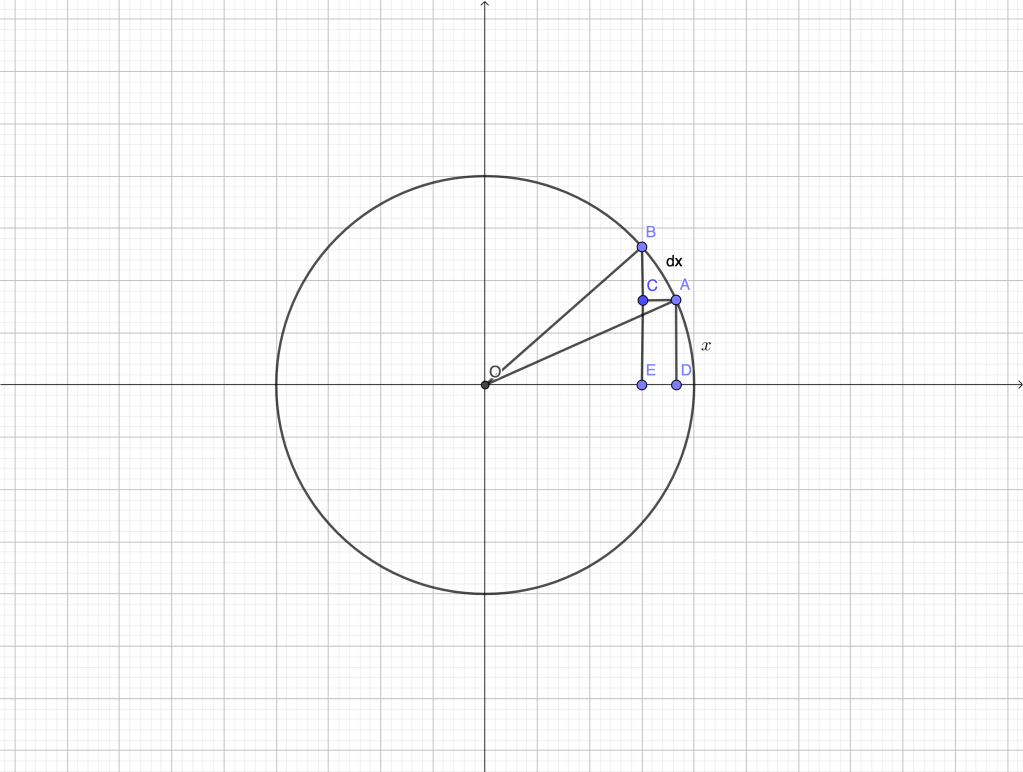
 is
is  . The triangles
  and
and  are similar since they are right and
  . Therefore,
 .
. is actually
  , etc. BUT it provides a visual, compelling reason as to why
  and the conclusion is absolutely correct. It is correct because we know that the vanishing circular arc
  is indistinguishable from its tangent, while
  .
.  . In the figure below,
  and
and  is right. Then
  . We increase the angle
  by an infinitesimal amount
  . The tangent is then increased by
  . Let
. Let  be the arc of a circle centered at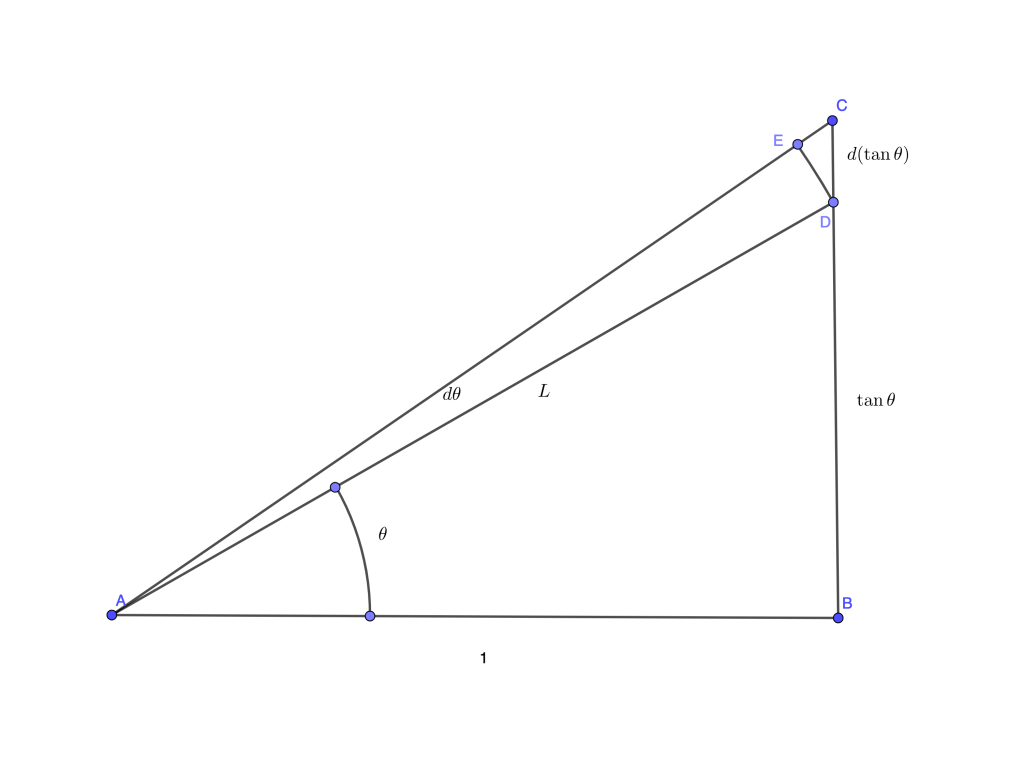
 are similar and thus

 differs from
  .
. and
and  be the lengths of the legs of the triangle. Then,

 . Thus we get a system of equations
 are allowed) we need zero determinant,
  which in our case implies
  and then, from our second finite relation we get
  .
. and substitute, leading to the problem of minimizing a function of
 and set it equal to zero. In this simple example there is no big difference, but notice that with our approach: a) no “independent variable” is singled out; b) we avoid the annoyance of taking the derivative of a square root; c)
 ,
,  . This problem involves more parameters and, no matter what quantity you choose as independent, the solution using derivatives is a bit messy. Using differentials, it reduces to a compatibility condition for a homogeneous linear system as above. Namely, we have
 .
.
 . Replacing
  and
and  in terms of
  and
and  we end up with a
  system for
  :
:
 . This in turn implies
 . Finally,
 .
. so the path should “reflect” on the line.
 .
. Math Bites